Donations
If you find this site
informative please donate, every
donation helps us keep up with hosting
costs. Thanks!
Warrants Alert
Books

THE INVESTOR'S GUIDE TO WARRANTS:
Capitalize on
the Fastest Growing Sector of the
Stock Market, Second Edition (Hardcover)
by Andrew McHattie Rating: ISBN-10: 027303751X

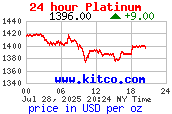
Platinum Prices
Palladium Prices
 How to Actually Value Stock Warrants
(Without Turning It Into Rocket Science)
How to Actually Value Stock Warrants
(Without Turning It Into Rocket Science)

#Most people don’t lose money on warrants because warrants are risky.
They lose money because they never truly understood **what they were paying for**.
A warrant price looks simple — $0.18, $0.32, $0.55 — but inside that number are four different ideas layered on top of each other: **intrinsic value, time value, leverage, and fair market value**. Until you separate those layers, warrants feel unpredictable. Once you do, they start behaving logically.
This article walks through those four ideas the way traders actually learn them: by connecting the math to real market behavior, in plain English, without hand‑waving or hype.
## Intrinsic Value: The Part That Exists Right Now
Intrinsic value is the anchor of all warrant pricing. It is the one piece that is not debatable.
Intrinsic value answers a very practical question: *If I exercised this warrant today, what would I receive?*
To calculate it, you take the current stock price and subtract the warrant’s exercise price. If the result is negative, intrinsic value is zero — because no one would exercise a warrant that lets them buy shares for more than the market price.
If a stock trades at $1.10 and the warrant’s exercise price is $0.60, the intrinsic value is $0.50. That $0.50 is real. It does not depend on forecasts, sentiment, or technical patterns. It exists whether the market notices it or not.
This is why intrinsic value matters so much. It creates a floor. When a warrant trades below its intrinsic value, the market is offering leverage at a discount. That discount may persist because of low volume or poor awareness, but the math itself does not change.
Seasoned traders treat intrinsic value as non‑negotiable. Beginners often overlook it — and that difference alone explains a large gap in outcomes.
## Time Value: What You’re Paying for Possibility
If intrinsic value is what exists today, time value is what *might* exist tomorrow.
Most warrants trade above intrinsic value because markets assign value to time. Time allows for price movement. Time allows volatility to work. Time allows stories to play out.
Time value is simply the portion of the warrant price that exceeds intrinsic value. If a warrant has $0.40 of intrinsic value and trades at $0.55, then $0.15 of the price is time value.
That $0.15 represents probability. It reflects how much upside the market believes could occur before expiration.
Here’s the part many beginners miss: time value is not stable. It slowly erodes as expiration approaches. Early in a warrant’s life, time value decays gently. Later, it decays aggressively.
This is why two warrants with identical intrinsic value can trade at very different prices if one expires in six months and the other in three years. Nothing mysterious is happening. The market is pricing time.
Experienced investors don’t just ask whether a warrant is cheap. They ask whether they are **overpaying for time**.
## Leverage: Why Small Moves Become Big Returns
Leverage is often treated like a buzzword, but in warrants it is simply math doing its job.
A warrant costs less than the underlying stock. Because of that, the same dollar move in the stock represents a much larger percentage move in the warrant.
Imagine a stock trading at $1.00 and its warrant trading at $0.25 with an exercise price of $0.70. If the stock rises to $1.40, the stock gains 40%.
The warrant’s intrinsic value at $1.40 becomes $0.70. The warrant didn’t just gain $0.45 — it gained 180%.
Nothing exotic happened. The leverage came from starting at a smaller number.
This is the upside — but leverage cuts both ways. If the stock stagnates, time value decays and the warrant can lose value even while the stock goes nowhere.
Understanding leverage means understanding *when* it works and *when* it quietly works against you.
## Fair Market Value: Where Math Meets Reality
Fair market value is the most misunderstood concept in warrant trading — and the most important.
The market price of a warrant is just the last trade. Fair market value is what the warrant *should* be worth based on intrinsic value, time remaining, volatility, interest rates, and dilution from new shares being issued upon exercise.
Because warrants trade in thin markets, price and value often drift far apart. A warrant can trade cheaply not because it is worthless, but because few people are paying attention.
This is where valuation tools come in. Option pricing models, while not perfect, help estimate what a warrant is worth under reasonable assumptions. Traders input the stock price, exercise price, time to expiry expressed in years, volatility, and a risk‑free rate.
The output is not truth. It is a reference point.
Since warrants cause dilution and often suffer from poor liquidity, experienced traders usually discount calculator values slightly. Even after that adjustment, the comparison between fair market value and trading price often reveals whether the market is mispricing probability.
When price is meaningfully below fair market value, the trade is no longer about direction alone. It becomes about **value convergence**.
## A Real‑World Example: Putting It All Together
Consider a Canadian small‑cap company trading at $0.75. Its warrant has an exercise price of $0.40 and just under three years remaining. The warrant trades at $0.22.
The intrinsic value is $0.35. The warrant is already trading below that number.
When time and volatility are run through a valuation model, the theoretical value comes back near $0.45. Applying a conservative discount for dilution and liquidity still leaves a fair market value estimate around $0.35 to $0.38.
The market price is $0.22.
That gap does not guarantee profit. But it explains *why* the warrant exists as an opportunity. The trader is not betting on hype — they are buying probability at a discount.
## Why This Framework Works
Beginners often look at warrants and ask, “Will it go up?”
Experienced investors ask a different question: “Is this priced correctly?”
By separating intrinsic value, time value, leverage, and fair market value, you stop reacting to price movement and start understanding it.
Warrants do not reward impatience or hope. They reward clarity.
When you know what you are paying for, warrants stop being intimidating and start behaving like what they really are — structured, measurable instruments designed to express long‑term conviction with defined risk.
That is when trading warrants becomes less emotional — and far more intentional.
Canadian News
Visitor Map
Popular
Pages
Warrant Terms
- Expiration Date: The last day the warrants can be exercised. If warrants aren't going to be exercised then they must be sold the day before the expiry date. The longer the time to expiry the more valuable the warrants.
- Leverage: A measure of how much you can increase your exposure to a share if you bought warrants instead of making a direct investment. It is the current share price divided by the current price of the warrant.
- Intrinsic Value: The difference between the exercise price and the actual trading price of the common stock. Once the common has gone over the exercise price, the warrants are "In the Money."
- Volatility: The higher the volatility rating, the higher the price of the warrant. Historical volatility is calculated by using the standard deviation of an underlying stock price over a specific period.
- Time Value: The difference between the current warrant price and its intrinsic value. Interpreted as the consideration paid for the advantage the warrant buyer has over the direct investor.
Charts
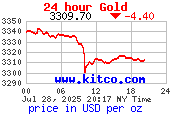
Gold Prices
Silver Prices
Visitors